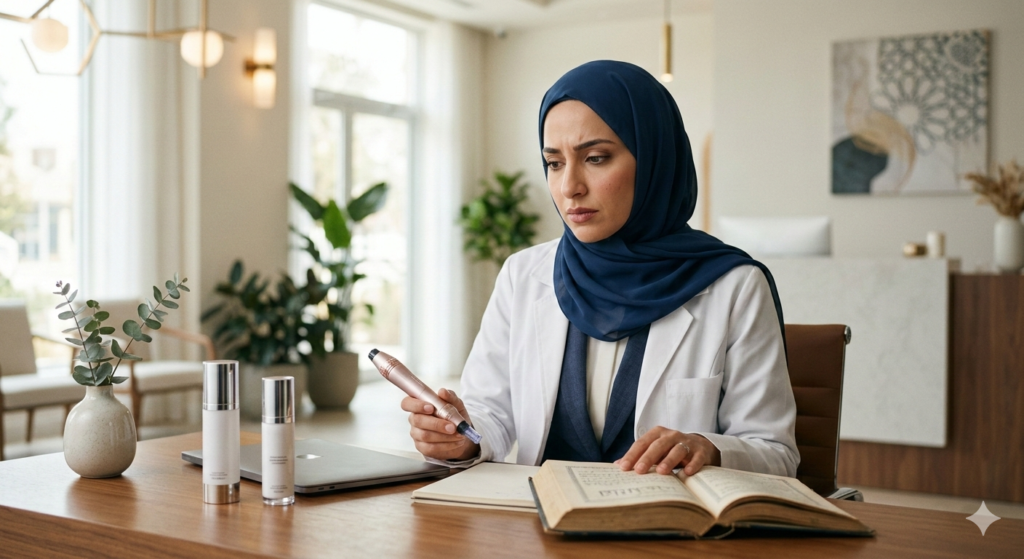
She sat across from me, confident and clear about what she wanted, a nose lift, no medical reason behind it, just a desire to look different.
I completed the consultation professionally. I answered her questions calmly. But when she left the room, I sat quietly for a moment and asked myself the same question I’d been carrying for years: Am I helping this person, or am I participating in something that displeases Allah SWT?
If you’ve ever felt that quiet unease that gap between your clinical confidence and your spiritual grounding this post is for you.
The Conflict I Carried Quietly for Years
When I graduated from Universiti Sains Malaysia (USM-KLE) International Medical Program in 2016, my purpose felt clear: heal, serve, and stay within the boundaries Allah had set for me.
But as I moved through housemanship, Obstetrics & Gynecology (O&G), and eventually into aesthetic medicine from 2020 onwards; laser treatments, PRP, HIFU — a question began to follow me into every consultation room. Is my income from this truly halal? Is what I’m doing actually okay Islamically?
I searched for answers everywhere. I asked my colleagues. I Googled late at night. I read opinion after opinion and some said beauty treatments are simply self-care and therefore fine, others said altering Allah’s creation is outright forbidden. None of it gave me peace, because none of it felt grounded enough, specific enough, or honest about the complexity of actual clinical work. That uncertainty became one of the biggest reasons I eventually decided to build my own practice, a space where I could set my own ethical standards without being pressured by KPIs to offer every procedure a patient requested.
What Aesthetic Medicine Actually Does Clinically Speaking
Before we can think about the ethics clearly, it helps to understand what aesthetic medicine actually involves at a clinical level.
Aesthetic medicine is a broad field of non-surgical medical treatments that address the skin, face, and body. This includes laser therapy for pigmentation and acne scarring, skin boosters for hydration, Botox for dynamic lines or medical conditions like jaw clenching and hyperhidrosis, dermal fillers for volume restoration, PRP for hair loss and skin rejuvenation, and minor surgical procedures like lipoma or xanthelasma removal. These are regulated medical procedures performed by licensed doctors — not beauty services. They sit on a wide spectrum, from clearly therapeutic to clearly cosmetic, with a large grey area in between.
That grey area is exactly where the Islamic question lives. Because not all aesthetic procedures are the same, the question is never simply “aesthetic or not?” It’s about what specifically is being done, why it’s being done, and whether it constitutes treatment and restoration or alteration of what Allah created without genuine need. That distinction is everything.
What the Mufti of the Federal Territory Actually Says
The turning point in my own journey came when I stopped looking for easy answers and started looking for grounded ones.
Irsyad Hukum No. 673, issued by Jabatan Mufti Wilayah Persekutuan, addresses this exact question: Is it permissible to work as an aesthetic doctor in Islam? The ruling is nuanced and important and it’s not a blanket prohibition.
The Mufti’s position, drawing on Surah Al-Nisa’ (4:119) and authenticated hadith, is this: performing procedures that alter the human body without necessity (hajat) is prohibited. But if the alteration is performed out of genuine need; reconstructive work after an accident, correcting a defect, restoring normal function, or treating a condition that causes real harm it is permissible (harus) in Islamic law.
The Mufti references the hadith of ‘Arfajah ibn As’ad (RA), a companion whose nose was severed in battle. The Prophet ﷺ permitted him to replace it which demonstrating clearly that correcting a genuine defect is not just allowed, but supported. At the same time, the Mufti cites the hadith narrated by Abdullah ibn Mas’ud (RA) in Sahih al-Bukhari, which warns against those who alter Allah’s creation for purely cosmetic purposes. Imam Ibn Hajar al-Asqalani explains this directly: the prohibition applies when alteration is done solely for aesthetics, while treatment and medical correction are permitted.
Understanding the Line in Practice
Based on this scholarly framework, here’s how I now think about the boundaries in my own practice.
Treatments that are generally permissible include: treating acne, pigmentation, melasma, and rosacea; reconstructive work after accidents or surgery; correcting birth defects causing physical or psychological harm; removal of benign growths like lipomas, cysts, and xanthelasma; and skin hydration treatments for legitimate dermatological improvement. Procedures that require careful consideration include Botox for medical conditions (where scholarly opinion leans toward permissible), PRP therapy (where opinions vary), and mild anti-aging treatments where intention and degree matter significantly.
Procedures that are generally not permissible without necessity include nose lifting or rhinoplasty purely for cosmetic preference, fillers to fundamentally restructure facial features without medical reason, and any treatment whose sole purpose is to appear younger against the natural process of aging. The Mufti makes one point that stayed with me deeply: the burden doesn’t sit only on the patient. A doctor who performs a forbidden procedure also bears responsibility, grounded in Surah Al-Ma’idah (5:2), the command to cooperate in righteousness and not in sin. This means not just refusing when asked, but proactively not presenting these options as if they are standard offerings.
The Ethical Reflection — Intention, Insecurity, and Necessity
Here’s what years of clinical practice have taught me about the space between permissible and prohibited: most patients don’t walk in wanting to defy Islamic values. They walk in tired of feeling embarrassed by their skin, exhausted by a scar that reminds them of something painful, or simply wanting to feel like themselves again after pregnancy or illness.
Intention matters enormously for the patient and for the doctor. The Prophet ﷺ said: “Actions are by intentions.” A doctor who enters this field to genuinely help, to offer ethical care in an industry that needs more grounded Muslim voices, to say no when a procedure crosses the line, that niyyah (niat) shapes everything. But intention alone doesn’t determine permissibility, and it doesn’t replace scholarly guidance. What it does is shape the kind of doctor you become. In a field where so much can go wrong with pressure to upsell, to satisfy every request, to hit revenue targets, a Muslim doctor with a clear ethical framework isn’t just professionally sound. She’s desperately needed.
Why I Finally Built My Own Practice
The clarity I found through Islamic scholarship didn’t just change my understanding it changed my direction.
Working in clinic environments where the pressure was real; sell the package, upsell the treatment, offer what the patient wants regardless of whether it was Islamically sound, was something I could no longer ignore once I had the knowledge to name what was wrong about it. Building my own practice meant I could finally say no to a procedure that crosses the line, without being overruled by a business owner. It meant I could counsel patients honestly, not just about medical outcomes, but about boundaries that matter. It was not an easy decision knowing the demand of the world we are currently living in. But the alternative — continuing to carry that quiet unease about whether my livelihood was truly blessed was no longer acceptable.
“Truly, Allah will always provide a way out for His servant who fears Him and seeks halal sustenance.” — Inspired by Surah At-Talaq (65:2-3)
A Message to You, If You Recognise Yourself in This
If you’re a Muslim doctor reading this and you recognise yourself in my story, the competence on the outside, the uncertainty within — I want you to know something: seeking clarity is not weakness. It is a mark of iman.
You don’t have to choose between your profession and your faith. But you do need knowledge to navigate the space between them wisely. The Mufti’s guidance in Irsyad Hukum No. 673 is not a fatwa against aesthetic medicine — it is a nuanced, scholarly framework that says: this work can be halal, but only if it is practised with awareness, intention, and boundaries. Find Syariah advisors who understand the medical field. Ask the hard questions. Then practise with confidence.
Your rizq is tied to your niyyah and your conduct, not just your skill. Let both be excellent.
References: Jabatan Mufti Wilayah Persekutuan. Irsyad Hukum Siri Ke-673: Hukum Bekerja Sebagai Doktor Bidang Kecantikan dan Kosmetik (Aesthetic). March 2022. · Sahih al-Bukhari (Hadith No. 4886, 5933) · Surah Al-Nisa’ (4:119) · Surah Al-Ma’idah (5:2) · Ibn Hajar al-Asqalani, Fath al-Bari, 10/373.
This post reflects my personal journey and clinical experience. It draws on published scholarly rulings but does not constitute a fatwa.