
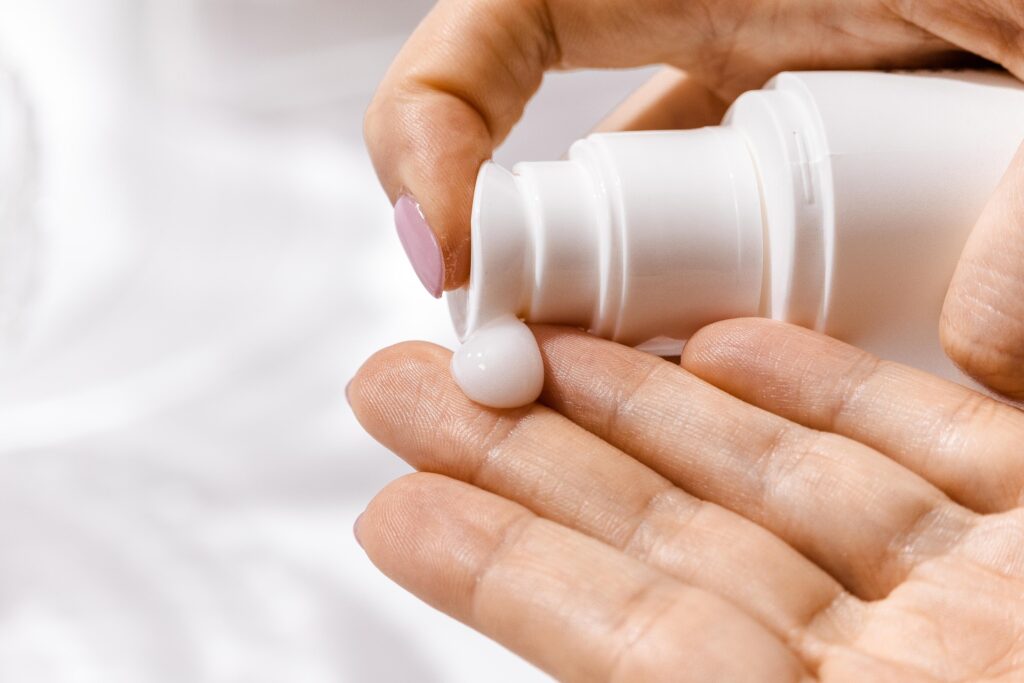
She held up two sunscreens side by side — one a lightweight Korean SPF fluid, the other a thick water-resistant mineral formula she’d been using for outdoor activities.
“Which one do I need to remove before wudu, Doctor?” she asked. “Or do I need to remove both?”
It’s one of the most common questions I get from Muslim women who take both their skincare and their ibadah seriously. And the answer — finally is not a vague “consult a scholar.” It’s grounded in actual science that maps surprisingly well onto Islamic jurisprudence.
The Question That Follows You Through Every Prayer Time
If you wear sunscreen daily and you should, living in Malaysia — you’ve probably stood at the sink before solat wondering whether your SPF is blocking your wudu.
Maybe you’ve been removing it every single time, then reapplying, then worrying your skin barrier is being stripped. Or maybe you’ve been leaving it on and quietly hoping for the best. Neither feels right. And the frustrating part is that most answers you find online are either too religious with no clinical grounding, or too clinical with no Islamic framework. You need both and that’s exactly what this post gives you.
The relief is this: not all sunscreens affect wudu the same way. Whether yours does depends entirely on its formulation and once you understand the science, the answer becomes straightforward.
The Fiqh Foundation — What Islamic Jurisprudence Actually Requires
Before we talk about your specific SPF, we need to understand what the Islamic ruling is actually based on.
Allah SWT says in Surah Al-Ma’idah (5:6): “…wash your faces and your forearms to the elbows and wipe over your heads and wash your feet to the ankles.” The foundational requirement for wudu is clear: water must physically reach the skin. Islamic jurisprudence does not require that your skin be completely bare — it requires that nothing with detectable physical substance prevents water from making contact.
Scholars draw a clear distinction here. Substances without physical body — oils, tints, and traces that dissolve completely in water — do not invalidate wudu. Substances with physical body and substance — those with detectable thickness that do not dissolve in water, must be removed. Mawlana Ilyas Patel (SeekersGuidance, reviewed by Shaykh Faraz Rabbani) specifically addresses chemical sunscreens: “It is rubbed into the skin, making it no longer traceable, and does not block the water from reaching the skin. Thus, one’s wudu will be valid.” So the key question is not whether sunscreen is present — it’s whether your specific sunscreen leaves a traceable physical layer on your skin surface.
The Science — Why Sunscreen Type Changes Everything
There are two fundamental types of SPF, and they sit on your skin in completely different ways.
Mineral (Physical) Sunscreen uses inorganic particles — zinc oxide (ZnO) and titanium dioxide (TiO₂) — that physically reflect UV rays. These particles rest on top of the skin. They do not absorb into it. This is what gives mineral sunscreens their characteristic white cast, and it’s also what makes them more likely to leave a detectable physical layer — the kind that scholars describe as forming a barrier. Chemical (Organic) Sunscreen works differently. It uses organic molecules that absorb UV radiation and convert it to heat, penetrating and integrating into the upper skin layers. When fully absorbed, a well-formulated chemical SPF leaves minimal traceable physical substance on the surface — which is consistent with the scholarly position that it does not obstruct wudu.
But there’s a second dimension that matters just as much: water resistance. Water-based sunscreens list Aqua/Water as the first ingredient. They’re lightweight, fast-absorbing, and wash off more easily — making them the lower-concern option for wudu. Water-resistant sunscreens are formulated with film-forming polymers — dimethicone, acrylate copolymers, PVP derivatives — that create an adhesive layer on the skin engineered to survive sweat and water exposure. This film is clinically significant: it’s physically substantial, does not dissolve easily in water, and presents a higher wudu concern. The most challenging combination of all? Mineral + water-resistant — zinc oxide or titanium dioxide combined with film-forming polymers. This creates the most physically substantial layer on skin and presents the strongest case for removal before wudu.
The Sunscreen-Wudu Quick Reference
| Sunscreen Type | Wudu Concern | What You Should Do |
|---|---|---|
| Water-based, light chemical SPF | Low | Wudu generally valid — no removal needed |
| Chemical SPF, non-water-resistant | Low | Wudu generally valid — no removal needed |
| Water-resistant chemical SPF (40–80 min) | Medium–High | Active cleansing recommended before wudu |
| Mineral SPF (non-water-resistant) | Medium | May leave residue — gentle cleanse recommended |
| Mineral + water-resistant SPF | High | Oil-based cleanser required before wudu |
| Water-resistant sport/outdoor SPF 50+ | High | Oil cleanse essential — not just water |
How to Identify Your Sunscreen Type — Check the Ingredients
You don’t need to memorise brand names. Just turn your sunscreen over and look at the ingredient list.
Signs it’s water-based: Aqua/Water is the first ingredient listed. Contains glycerin, hyaluronic acid, or niacinamide. Labelled as gel, fluid, essence, or serum-type. No “water resistant” claim on the packaging. Feels watery and fast-absorbing on your skin. Signs it’s water-resistant: Labelled “water resistant 40 min” or “80 min.” Contains dimethicone, cyclopentasiloxane, or acrylates copolymer. Feels slightly tacky or film-forming after application. Hard to rinse off with water alone. Designed for sport, outdoor, or active use.
What About Micellar Water? Is It Enough?
This is the question I get most often after the wudu question itself — and the answer is: it depends.
Micellar water contains tiny structures called micelles — surfactant molecules that trap oily impurities and lift them from the skin. It’s gentle, alcohol-free, and convenient. But it has a significant limitation: it contains low concentrations of surfactant. Research from Skin Research and Technology (2021) found that micellar water only removed 65–73% of SPF 50+ sunscreen in a single pass — with residual particles remaining around the nose, hairline, and jawline. A double cleanse with oil cleanser followed by a foaming cleanser achieved over 95% removal. Kong et al. (2019, PubMed) found that water alone left 54% residue on non-waterproof SPF. A cleanser reduced this to 15.6%. A cleansing oil brought it to 13.4%. For waterproof SPF, only cleansing oil achieved meaningful removal.
| Sunscreen Type | Micellar Water Alone | Better Approach |
|---|---|---|
| Water-based, light chemical SPF | Mostly sufficient | Micellar water + gentle rinse |
| Chemical SPF, non-water-resistant | Generally sufficient | Micellar water + water rinse |
| Water-resistant chemical SPF | Partially only | Micellar first + follow with cleanser |
| Mineral SPF (non-water-resistant) | Partially only | Follow with gentle cleanser |
| Mineral + water-resistant SPF | Not sufficient | Oil-based first cleanse required |
| Water-resistant sport/outdoor SPF 50+ | Not sufficient | Oil cleanse essential |
Micellar water is not useless — it’s situational. On light SPF days, it plays a valid role. The problem is using it as a complete solution when your formula actually demands more.
The Honest Reflection — Science Meets Intention
Here’s something I find genuinely beautiful about this topic: Islamic jurisprudence and skin science align more closely than most people expect.
Scholars don’t require bare skin — they require that water reaches the skin. Scientists confirm that different sunscreen formulations leave meaningfully different levels of physical residue. The woman wearing a lightweight water-based chemical SPF every day is in a very different position from the woman using a water-resistant zinc oxide formula for a day at the beach. Both are protecting their skin, which is an act of caring for the amanah Allah entrusted to them. But they need different cleansing approaches before wudu and now you have the science to know exactly which category you’re in. Taking care of your skin and maintaining your solat with peace of mind are not in conflict. You just need the right information to do both properly.
A Gentle Closing
The next time you stand at the sink before solat, you don’t have to guess.
Check what’s in your SPF. If it’s a light, water-based chemical formula — wudu generally valid, carry on. If it’s a water-resistant or mineral formula — cleanse properly first, and protect your skin barrier by choosing a gentle method appropriate for your formula. Part Two of this series covers the exact step-by-step cleansing protocols for light SPF days, full makeup days, and a practical daily prayer-time strategy — without stripping your skin.
You deserve to feel settled, not anxious, before every prayer.
This post is written for patient education purposes. Clinical references: Islam Q&A (islamqa.info, March 2024), SeekersGuidance — Mawlana Ilyas Patel reviewed by Shaykh Faraz Rabbani (Oct 2022), Kong et al. (PubMed, 2019), Skin Research and Technology (2021).
For religious rulings specific to your personal circumstances, please consult qualified Islamic scholars.