She’d been living with acne scars for almost eight years.
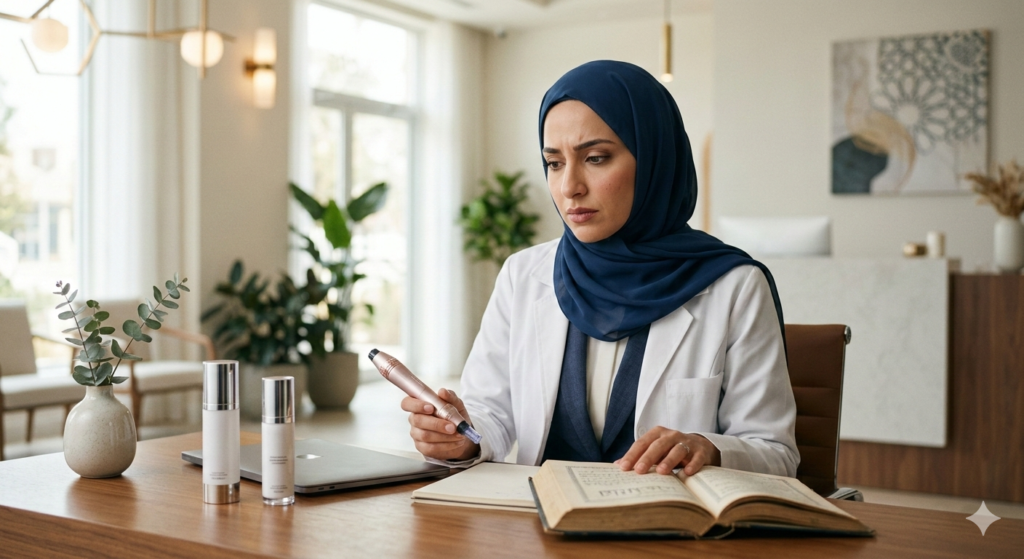
She’d tried every cream, every serum, every home remedy someone on TikTok recommended — and nothing had made a real difference. When her dermatologist finally suggested laser treatment, her first response wasn’t excitement. It was hesitation. “But is it okay for me to do this as a Muslim?”
If that question sounds familiar, keep reading — because you deserve a clear answer, not more confusion.
The Guilt That Stops Muslim Women From Getting Help
There’s a particular kind of guilt that follows Muslim women into aesthetic clinics and I’ve seen it hundreds of times.
You want to address something real. A skin problem that’s affecting your confidence, your daily life, maybe even how you show up in your marriage or your work. But the moment you start looking into treatment options, a voice in your head asks: Is this vanity? Am I being ungrateful for what Allah gave me? Is this even allowed? That internal conflict is exhausting and it often stops women from seeking help they genuinely need. What makes it worse is that most of the information online is either too technical to understand, too casual to trust, or completely ignores the Islamic dimension altogether. You’re left Googling in circles, none the wiser, and still carrying the guilt.
The truth is, Islam has always had a thoughtful, nuanced position on beauty and self-care — one that’s far more generous than the guilt you’ve been carrying. But understanding it properly requires going beyond surface-level opinions and actually looking at what scholars have said.
What Is Facial Laser Treatment, Exactly?
Facial laser treatment is not one single procedure — it’s actually a broad category of non-surgical treatments that use focused light energy to target specific concerns in the skin.
Different laser wavelengths are absorbed by different targets in the skin. A laser for pigmentation targets melanin — the pigment cells causing dark spots, uneven skin tone, or melasma. A laser for acne and active breakouts targets the bacteria and sebaceous glands involved. A laser for scarring or skin texture works by creating controlled micro-injury in the deeper layers of skin, triggering the body’s natural healing response and stimulating collagen production. Lasers used for vascular concerns — like redness or small visible blood vessels — target the blood vessel walls directly. In every case, the mechanism is the same: using light energy to either destroy a problematic target or stimulate the body’s own repair process.
This is why facial laser is used across such a wide range of concerns — acne, acne scarring, pigmentation, melasma, uneven skin tone, fine lines, rosacea, and early signs of aging. These aren’t trivial cosmetic complaints for most of the women who seek treatment. Persistent acne that leaves scars affects self-esteem in ways that are deeply real. Melasma that spreads across the face during pregnancy and doesn’t fade is a medical dermatological condition. Rosacea that causes visible redness and discomfort is not just an aesthetic issue. Understanding the clinical breadth of what facial laser treats is important because it directly affects how we think about its permissibility in Islam.
What Does Islam Say? The Scholarly Framework
The good news here is that Islamic scholarship is not silent on this, and the position is more straightforward than you might expect.
The starting point in Islamic jurisprudence (fiqh) is actually quite affirming. Allah SWT says in Surah Al-A’raf (7:32): “Say: Who has forbidden the adornment of Allah which He has brought forth for His servants?” The basic Islamic position on beauty and adornment is that it is permitted — there is no blanket prohibition on caring for your appearance. The principle in Islamic jurisprudence (fiqh) is that the original ruling for adornment and self-care is permissible (harus), unless there is specific evidence prohibiting it. Taking care of your skin and your health is not just allowed — it is considered part of maintaining the trust (amanah) of the body Allah gave you.
Scholars who have addressed aesthetic treatments distinguish clearly between two categories. The first is treatment — addressing an existing skin problem, correcting damage, or restoring the skin to its original healthy state. This includes treating acne, acne scarring, pigmentation, melasma, rosacea, and similar conditions. Scholars are consistent that this type of treatment does not fall under the prohibition of “altering Allah’s creation” because its purpose is restoration and healing, not permanent transformation. The second category is enhancement beyond the original — procedures done purely to look different or better than your natural baseline, with no underlying skin condition driving it. This requires more careful consideration of intention and degree, though scholars note that if a woman does this to look attractive for her husband, many permit it as part of the rights and care within a marriage. The important condition in both cases: the treatment must be performed by a qualified practitioner, and health risks must be assessed properly before proceeding.
The Honest Question — Where Does Your Reason Sit?
Here’s where I want to be genuinely honest with you rather than just reassuring.
Most women seeking facial laser treatment have a real, legitimate clinical reason and they don’t even realise that the scholarly framework actually supports what they want to do. The woman with years of acne scarring that affects her confidence every time she looks in the mirror? That’s treatment. The woman with melasma that spread during her last pregnancy and won’t fade? That’s treating a dermatological condition. The woman with rosacea causing redness and discomfort? Also treatment. But here’s the honest part: you need to sit with your own intention clearly, not just find the category that gives you permission. The Prophet ﷺ said “actions are by intentions” and that applies to the decisions you make about your body too. A doctor can assess your skin. A scholar can guide your understanding of the ruling. But only you know the true reason you’re seeking treatment and being honest with yourself about that is part of making a decision you’ll feel genuinely settled about.
Practical Things to Consider Before You Book
Before you make any appointment, here are the things I’d encourage you to think through and discuss with your doctor.
What is the specific skin concern you’re addressing, is there a clinical diagnosis behind it, or is it a general desire to look better? Not because one is more valid than the other emotionally, but because it matters for understanding which scholarly category applies to your situation. Is the clinic you’re considering using a qualified, licensed doctor to perform the laser or is it a beauty therapist or unqualified operator? This matters both medically and Islamically; the scholars specify that treatment must be performed by someone qualified. And what are the realistic outcomes being promised to you? A good doctor will be honest about what laser can and cannot achieve and won’t sell you a package of sessions before assessing whether you’re even a suitable candidate.
You’re Not Vain for Wanting to Address Your Skin
Let me say this clearly, because I think a lot of Muslim women need to hear it.
Wanting to treat your acne scars is not vanity. Wanting to address pigmentation that’s been bothering you for years is not vanity. Taking care of the skin Allah gave you — treating damage, addressing conditions, restoring your skin to a healthy state is not ingratitude. The Quran itself pushes back on the idea that beauty and adornment are inherently suspicious. Islam honours the body as an amanah — a trust and caring for it properly is part of how we honour that trust.
What the scholars caution against is a very specific thing: permanently altering your God-given features purely out of dissatisfaction with how Allah made you, or you wanted to look like someone you admire, with no clinical basis and no genuine need. That’s a different conversation entirely and it’s not the conversation most women seeking laser treatment for their skin are actually having.
A Gentle Closing
You’ve been carrying this question quietly long enough.
Facial laser treatment for treating skin conditions, correcting damage, and restoring your skin’s healthy state is based on established Islamic scholarly principles permissible. It is not considered “changing the creation of Allah” when its purpose is treatment and restoration. Go to a qualified doctor. Have an honest conversation about what your skin actually needs. Ask the hard questions about what results are realistic. And bring your specific situation to a qualified scholar if you have doubts that go beyond what a general blog post can address.
You deserve both good skin health and spiritual clarity. The two are not in conflict here.
This post is written from a clinical and educational perspective, drawing on established Islamic jurisprudential principles and scholarly references including Jabatan Mufti Wilayah Persekutuan guidelines. It does not constitute a fatwa or personal religious ruling.
For religious rulings specific to your personal circumstances, please consult qualified Islamic scholars.